department of neurology  
  neurology header  
  Address: The Neurological Institute of New York, 710 West 168th Street, 3rd Floor, New York, NY 10032  


FELLOWSHIP PROGRAMS


Subspecialty Fellowship Offered


Movement Disorders Fellowship program


Fellowship Directors


STANLEY FAHN, MD


H. Houston Merritt Professor of Neurology
Director, Center of Parkinson’s Disease and Other Movement Disorders
Email: sf1@columbia.edu

ROY ALCALAY, MD, MS


Assistant Professor of Neurology
Center of Parkinson’s Disease and Other Movement Disorders
Email: rna2104@columbia.edu

former and current fellows

See some of our former and current fellows

(link opens a new window)

movement disorders fellowship

FELLOWSHIP PROGRAM


Stanley Fahn, MD

Clinical Fellowship Program:


The Movement Disorders Fellowship Program at CUMC is usually a 2-year training program, although some fellows have trained for as little as 1 year or as much as 3 years. The subspecialty of movement disorders is not an ACGME accredited program.

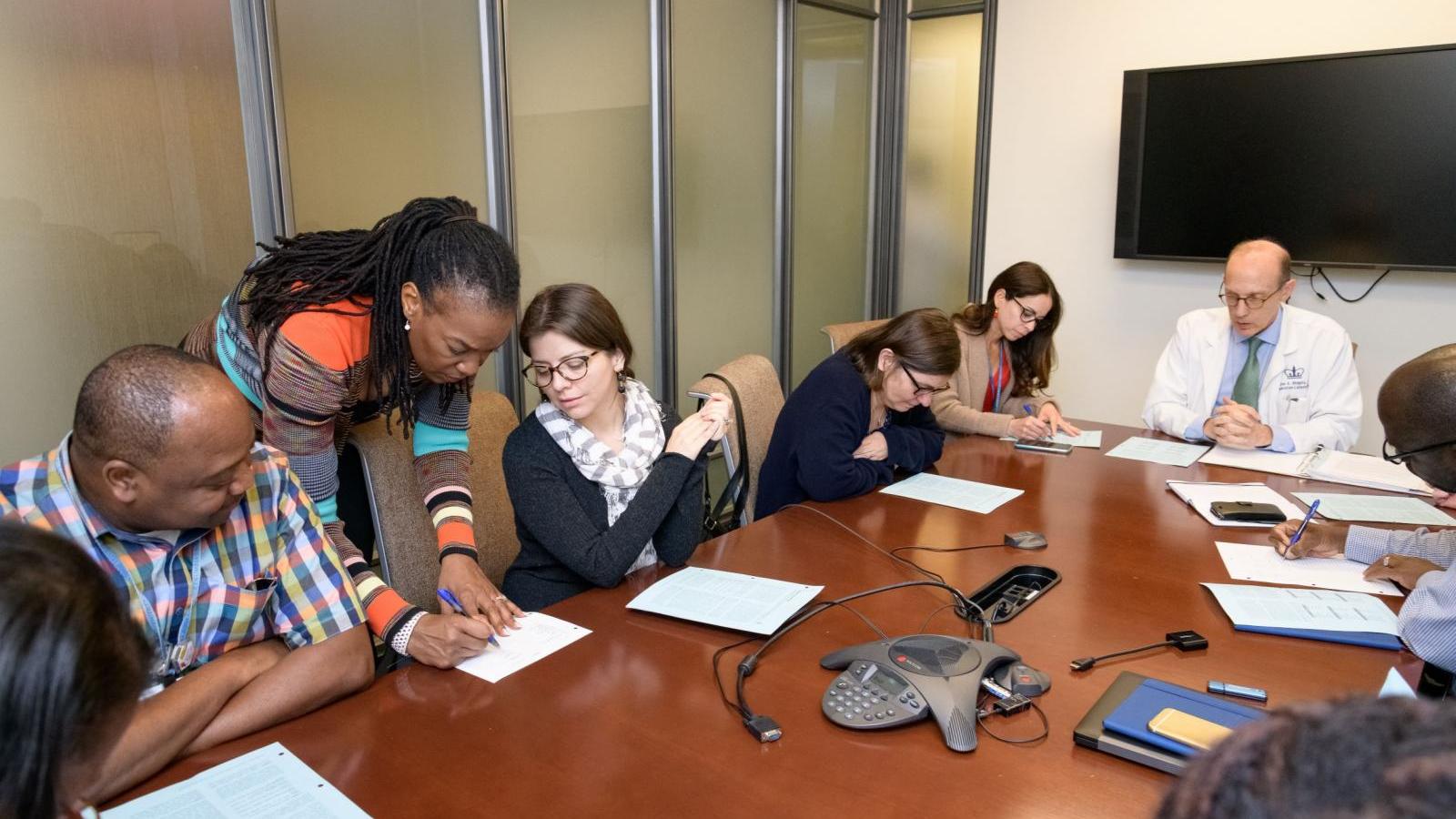
The goal of the clinical fellowship program is to train neurologists to become experts in the diagnosis and treatment of movement disorders, and to develop skills in clinical or basic science research. The core component of their clinical education consists of learning how to diagnose and treat movement disorders by evaluating outpatients and hospitalized patients with these neurologic conditions at CUMC. The Fellows work directly with the movement disorder faculty. The fellows perform clinical evaluations of patients under the attendings' direct supervision, and they follow the patients regularly with phone calls to make adjustments to their treatment and subsequent outpatient evaluations. They review management decisions with the attendings.

In addition to dealing directly with patients, fellowship education is also provided by weekly conferences in which patients' clinical problems are discussed along with review of videotaped neurologic examinations ("video rounds"); presentation of individual patients in conference ("patient rounds"), monthly clinicopathologic conferences (CPCs) made possible by an active brain and video collection program, twice monthly journal clubs, and monthly research conferences in which the basic science and clinical faculty present their current research results. There are sessions after national and international neurology and movement disorder meetings where the important papers presented are discussed. Journal club is held on selected topics.

Clinical fellows gain familiarity with rating scales and develop a core of clinical and basic science knowledge relevant to the field of movement disorders. Fellows learn the techniques and therapeutic use of botulinum toxin injections for dystonia, hemifacial spasm, and related disorders. They have the opportunity to learn the techniques of programming for deep brain stimulation and motor control physiology, develop skills in research design and data analysis, and develop experience in clinical trials and epidemiology.

Each fellow is given a laptop computer and a digital video camera while with us. All patients are asked to give permission for being videotaped so that their movements can be followed over time. The diseases encountered are Parkinson disease, atypical parkinsonism, cerebellar ataxia, chorea, dystonia, myoclonus, paroxysmal dyskinesias, tardive dyskinesia, tics, tremors and psychogenic movement disorders. Less common types of movement disorders are also encountered. A description of the types of patients encountered by the fellows has been published [Portera-Cailliau C, Victor D, Frucht SJ, Fahn S. Movement disorders fellowship training program at Columbia University Medical Center in 2001-2002. Mov Disord 2006 Apr;21(4):479-485]. The first year of the clinical fellowship program consists of four half-days a week in a clinic supervised by individual faculty members, working with and being mentored by three to four movement disorder faculty members, one for each session. Each of these four specific weekly sessions is supervised by the same faculty member for consistency and follow-up care. The Fellow sees each patient first (obtaining a history and performing a neurologic and a movement disorder examination) and then presents the patient to the faculty member. Following that, the patient is discussed in terms of a differential diagnosis, a working diagnosis and a plan for treatment. Another half-day per week is set aside to take care of the patients who cannot afford private physician fees including those covered by Medicaid insurance. This weekly clinic evaluates patients predominantly from the surrounding neighborhood. The faculty rotates through this clinic, and the fellow presents the patient to the faculty member. All patients encountered in any of these five outpatient clinics is followed throughout the fellowship by the assigned fellow, who prepares the consultation report back to the referring physician, handles all telephone inquiries, and arranges laboratory tests and treatment schedules. If any of the patients requires hospital admission, the fellow follows the patient during the hospital stay. The fellow may spend another half-day per week in our botulinum toxin injection clinic, which is a powerful method for treating a variety of movement disorders, especially torsion dystonia. The other half-days are available to become involved in research projects.

Patients with movement disorders may be admitted to the hospital for other neurologic or medical problems, and the Movement Disorder Division is often asked to consult on these patients. Clinical movement disorder fellows in both the first and second years provide these in-patient consultations, assigned on a rotating basis. The fellow sees the patient first, writes a consultation note, and then sees the patient again with a movement disorder faculty attending to discuss the patient in detail.

The second year of the fellowship is designed on an individual basis dependent on the fellow's career goal (research versus clinical). Second-year clinical fellows will be assigned different faculty members from whom they are mentored during the first year. The second-year clinical fellow will have the same schedule as in the first year with one fewer half-day private clinic in order to allow the fellow to become more involved in research and to provide elective time to learn DBS programming and to rotate in the operating suite to observe DBS surgery. There is also the opportunity to work with Dr. Seth Pullman in his motor control physiology lab, learning techniques such as tremor analysis, back-averaging for myoclonus, and injecting botulinum toxin into limbs for limb dystonia.

Fellows who choose the research track in the second year may spend only one day a week in the clinical unit evaluating patients that year and the other 4 days in 1) a basic research laboratory, 2) a clinical research lab, 3) in Columbia's neuroepidemiology fellowship program or 4) in Columbia's Clinical Research Master's Degree program. The latter two are 2-year programs, which means the fellow will be with us for a total of 3 years. All four options are dependent upon the fellow being accepted by the specific lab chief or Master Degree program, respectively. The goal of the research tracks is to prepare the fellows for a successful submission of mentored grant applications to the American Academy of Neurology, private foundations, or the NIH. Our fellowship track record in the past 3 years includes an NIH K08 and a K12 award, a Brookdale Foundation award, and 2 AAN fellowship awards.

The faculty meets quarterly to discuss each fellow's progress, and a report is issued to the fellow. Clinical Faculty members are Drs. Stanley Fahn, Roy Alcalay, Blair Ford. Paul Greene, Oren Levy, Elan Louis, Pietro Mazzoni, Toni Pearson, Cordelia Schwarz, and Cheryl Waters. Roy Alcalay is the Fellowship Director.

Each clinical fellow must have successfully completed a neurology residency program and have been interviewed by the faculty before being admitted to the program. International applicants are required to have received an ECFMG certificate prior to applying for the fellowship. A New York State medical license is required to see patients.

Columbia is a member of a consortium with other movement disorder fellowship training programs in which a matching plan is utilized, and all consortium members notify fellowship candidates of acceptance on the same date.

The Columbia Clinical-Basic Science Fellowship Program:


The primary goal of this combination fellowship is to provide both the clinical training and an experience in research design and laboratory techniques devoted to addressing basic questions in movement disorders, using tools of modern molecular genetics, immunohistochemistry, biochemistry, pharmacology and animal models. Specific techniques employed include stereotaxic brain injections of toxins, monitoring animal behavior, receptor binding assays, receptor autoradiography, assays of neurotransmitter agents and metabolites in tissues and body fluids using high-performance liquid chromatography, tissue culture, immunohistochemistry, enzymatic assays, molecular biology of DNA mapping, and developing mouse genetic models of movement disorders, including Parkinson’s disease and torsion dystonia. It is anticipated that graduates of the lab fellowship will develop careers as laboratory researchers in the field of movement disorders. Current projects include studies on dopamine, acetylcholine and other neurotransmitters and their receptors, evaluation of potential therapeutic agents, production of animal models of movement disorders, transplantation in animal models, molecular genetics and pathogenic mechanisms of neurodegeneration. Movement Disorder Faculty heading our basic science laboratories are Drs. Robert Burke, Serge Przedborski, Oren Levy, David Sulzer, Ai Yamamoto and Lloyd Greene. Our group has been recognized as a Morris K. Udall Parkinson’s Disease Center of Excellence by N.I.H.

The first year of fellowship in this Combination Program is a pure clinical fellowship. The second year fellowship is spent in a research lab, with only one-half day a week seeing patients in order to maintain clinical skills. A joint 3-year program with neuroepidemiology training is available on a competitive basis, enabling one to be trained in both movement disorders and neuroepidemiology. The first year is a pure clinical year, and the next 2 years are predominantly epidemiology with 2 half-days of clinical care.

Research and Funding Opportunities


Clinical and laboratory fellows participate in ongoing research projects and are encouraged to develop their own ideas and research. The Program fosters a stimulating academic environment that helps young investigators successfully compete for grants.

How to Apply for the Fellowship Program:


Our program participates in the San Francisco Match for Movement Disorders Fellowship Match. In order to apply to our fellowship applicants should register through the SF match website http://www.sfmatch.org/index.htm and submit to us directly (by email or snail mail) the following documents: a letter requesting a fellowship interview, a personal statement explaining the candidate's interest in movement disorders and her/his future goal, and a curriculum vitae and bibliography.

Also required, but sent in separately, are at least three letters of recommendation, addressed to Dr. Fahn, with one letter being from the candidate's department's chairperson. There is no separate, identifiable application form.

Applications should be submitted during PGY3. No candidate is accepted without undergoing a formal interview process, whereby the candidate meets the movement disorder faculty. Interviews take place from May through August of PGY4 (9-12 months before starting the fellowship). We accept international applicants and support J1 visa. Applicants however should be eligible for a New York State License, which requires an ECFMG certificate from all candidates who graduated medical schools outside the USA or Canada. The date of the match for the July 2013 fellowship start date was Sept. 7, 2012. The date of the match for July 2014 start date remains to be determined.


Sitemap | Email Comments

Copyright © 2004 The Neurological Institute of New York || Columbia University Medical Center Center for Parkinson Disease & Other Movement Disorders
Affiliated with New York-Presbyterian Hospital
710 W 168th St, New York, NY 10032
Last updated: July 3, 2012
 

ABOUT US:

- MISSION STATEMENT
- OUR DOCTORS
- CONTACT & DIRECTIONS
PATIENT INFORMATION:

- OUR DOCTORS
- WHAT ARE MOVEMENT DIORDERS?
- CLINICAL CARE
- CLASSIFICATION OF MOVEMETN DISORDERS
- GLOSSARY OF MOVEMENT DISORDERS TERMS
- WHY DO I NEED A MOVEMENT DISORDERS SPECIALIST?
- MOVEMENT DISORDERS & FAMILY HISTORY
- GENETIC COUNSELING
- MOVEMENT DISORDERS SURGERY CENTER
- BRAIN BANK
- CLINICAL MOTOR PHYSIOLOGY LABORATORY
- CONTACT & DIRECTIONS

EDUCATION:

- MOVEMENT DISORDERS FELLOWSHIP
- FORMER AND CURRENT FELLOWS
RESEARCH:

- BASIC SCIENCE RESEARCH
- CLINICAL RESEARCH
- CLINICAL RESEARCH STUDIES
- GENETIC RESEARCH